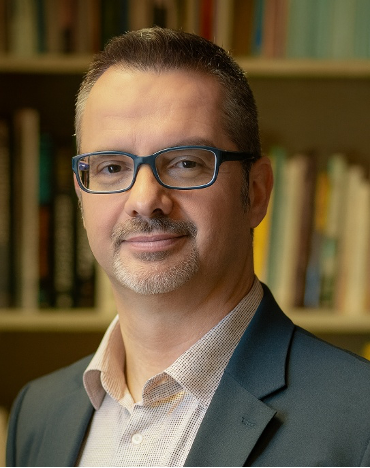
 Davide Tanasi
KEYNOTE LECTURE
High Resolution 3D Metrology for Roman Architecture and Heritage Analysis
Davide Tanasi
University of South Florida, USA
ABSTRACT
Over the last two decades, three-dimensional documentation has become a standard component of archaeological recording and heritage management. Yet despite significant advances in sensor technology and processing workflows, 3D data are still too often treated as isolated snapshots tied to individual field campaigns rather than as cumulative, metrically coherent research assets. This presentation argues for a shift in perspective, proposing the treatment of high-resolution 3D documentation as a form of long-term research infrastructure grounded in metrology. Drawing on a longitudinal digital documentation project at the western bath complex of the Villa Romana del Casale in Sicily, this talk explores the methodological and interpretive potential of integrating terrestrial laser scanning and LiDAR datasets acquired over multiple field seasons. By reunifying legacy and newly collected data into a single, metrically reliable digital surrogate, it becomes possible to move beyond visual representation toward quantitative spatial analysis. In particular, the availability of a unified, high-precision point cloud enables the calculation of room volumes, spatial relationships, and structural metrics that are essential for functional interpretation, including studies of heating systems, energy expenditure, and water management in Roman bath architecture. The presentation will address the technical challenges inherent in multi-sensor, multi-temporal integration, including issues of accuracy, point density, registration, and error propagation, while emphasizing the role of metrological rigor in ensuring data comparability through time. At the same time, it will highlight how such datasets support conservation planning by enabling millimetric monitoring of structural change and surface deformation. Ultimately, this contribution positions metrology not simply as a tool for documentation, but as a conceptual framework for digital continuity in archaeology. By embedding precision, reuse, and longitudinal thinking at the core of 3D workflows, digital data can evolve from descriptive records into durable analytical infrastructures that bridge archaeology, heritage science, and conservation practice.
SPEAKER BIOGRAPHY
Davide Tanasi is Professor of Digital Humanities and Archaeological Sciences at the University of South Florida, where he also serves as Director of the Institute for Digital Exploration (IDEx). His research focuses on the integration of advanced digital technologies, including terrestrial laser scanning, LiDAR, photogrammetry, GIS, and 3D data curation, into archaeological research, heritage science, and conservation practice, with a strong emphasis on methodological rigor and long-term data reuse. Trained as an archaeologist, Tanasi has conducted extensive fieldwork across the Mediterranean, particularly in Sicily and Malta, where he directs and co-directs multiple long-term archaeological and digital documentation projects. His work bridges traditional archaeological interpretation with quantitative spatial analysis, exploring how high-resolution 3D data can support functional studies of ancient architecture, landscape analysis, and conservation monitoring. A recurring theme in his scholarship is the treatment of digital documentation as cumulative research infrastructure rather than as isolated recording events. He has authored or co-authored nearly 300 scholarly publications, including peer-reviewed journal articles, edited volumes, and conference proceedings, and his work has appeared in high-impact international venues. As Director of IDEx, Tanasi oversees one of the largest academic digital heritage research facilities in the United States, supporting interdisciplinary collaborations with archaeologists, conservators, forensic scientists, engineers, and cultural institutions. Through his research and leadership, Davide Tanasi advocates for a metrology-driven approach to digital archaeology that foregrounds precision, transparency, and reuse as foundations for sustainable heritage research and conservation.